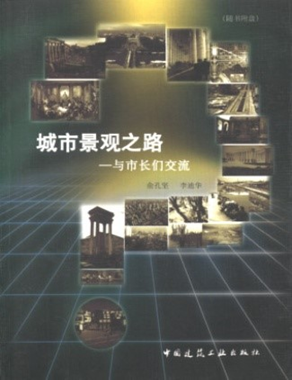
The Path of Urban Landscape: Conversations with Mayors
Authors: Yu Kongjian, Li Dihua
Publisher: China Architecture & Building Press
Publication Date: January 2003
| 
|
Synopsis: This seminal theoretical work on urban landscape planning, published in 2003 by Yu Kongjian and Li Dihua, critiques formalist-driven urban beautification campaigns and advocates for planning methods prioritizing ecological principles. Structured in three parts, the book constructs a logic that balances critique with constructive proposals:
In Part One, the authors review history, deeply analyzing the lessons from the late 19th-century American city beautification movement. By examining case studies such as Baroque-style cities (symbolizing monarchical absolutism), colonial cities (reflecting imperialist influence), and cities under fascist rule (serving as platforms for dictatorial power displays), they reveal the political power alienation concealed behind formalized landscape design. The book emphasizes that urban landscape design should transcend superficial visual beautification and avoid becoming a symbolic tool for power displays.
The middle section focuses on China, dissecting the widespread “urban beautification campaigns” that emerged since the 1990s. The author argues this phenomenon represents a blend of feudal authoritarian consciousness, ostentatious wealth display, and small-scale peasant economic thinking. This manifests in six primary issues: landscape boulevards disrupting urban fabric; plaza designs neglecting human usability; river channelization damaging ecosystems; park construction prioritizing spectacle over function; residential beautification lacking practical value; and large-scale tree transplantation violating ecological principles. For instance, rivers are artificially straightened and cement-lined, diminishing their self-purification capacity, while wide boulevards pose pedestrian safety hazards.
In the subsequent section, the author proposes innovative solutions: the “anti-planning” theory and the strategy of ecological infrastructure development. The “anti-planning” concept overturns the traditional “population-function-layout” planning model, advocating first identifying areas unsuitable for development. By establishing an ecological security framework, it protects key elements such as natural landscapes, indigenous ecosystems, and natural waterways, thereby building the city's ecological infrastructure. For instance, preserving rivers' natural forms allows them to function as “sponges” regulating droughts and floods, while establishing green transportation corridors prioritizing non-motorized vehicles reduces dependence on automobiles.
The book consistently pursues the ideal of harmonious coexistence between “Heaven, Earth, and Humanity,” emphasizing that landscape design must integrate ecological safety (e.g., wetland purification functions), cultural value (e.g., reflecting local characteristics and spirit), and spaces suitable for human life (such as human-centered public spaces). In the preface, renowned scholar Academician Zhou Ganqi notes that this book specifically targets urban decision-makers—as formalistic tendencies often stem from leadership decisions—urging a shift from purely performance-driven approaches to more rational ecological principles.
Concluding with the theme of “returning to authenticity,” the book advocates restoring nature's true form, human-scale dimensions, and the unique charm of local culture in urban landscape design. It stands as a vital theoretical reference for China's ecological city planning and construction. More than a theoretical treatise on landscape design, it serves as a practical guide tailored for urban administrators, offering scientific pathways and vision for building a truly livable, sustainable, and beautiful China.
