Professor Yu Kongjian Delivers “First Lecture for New Students”: Ecological Civilisation and a Beautiful China
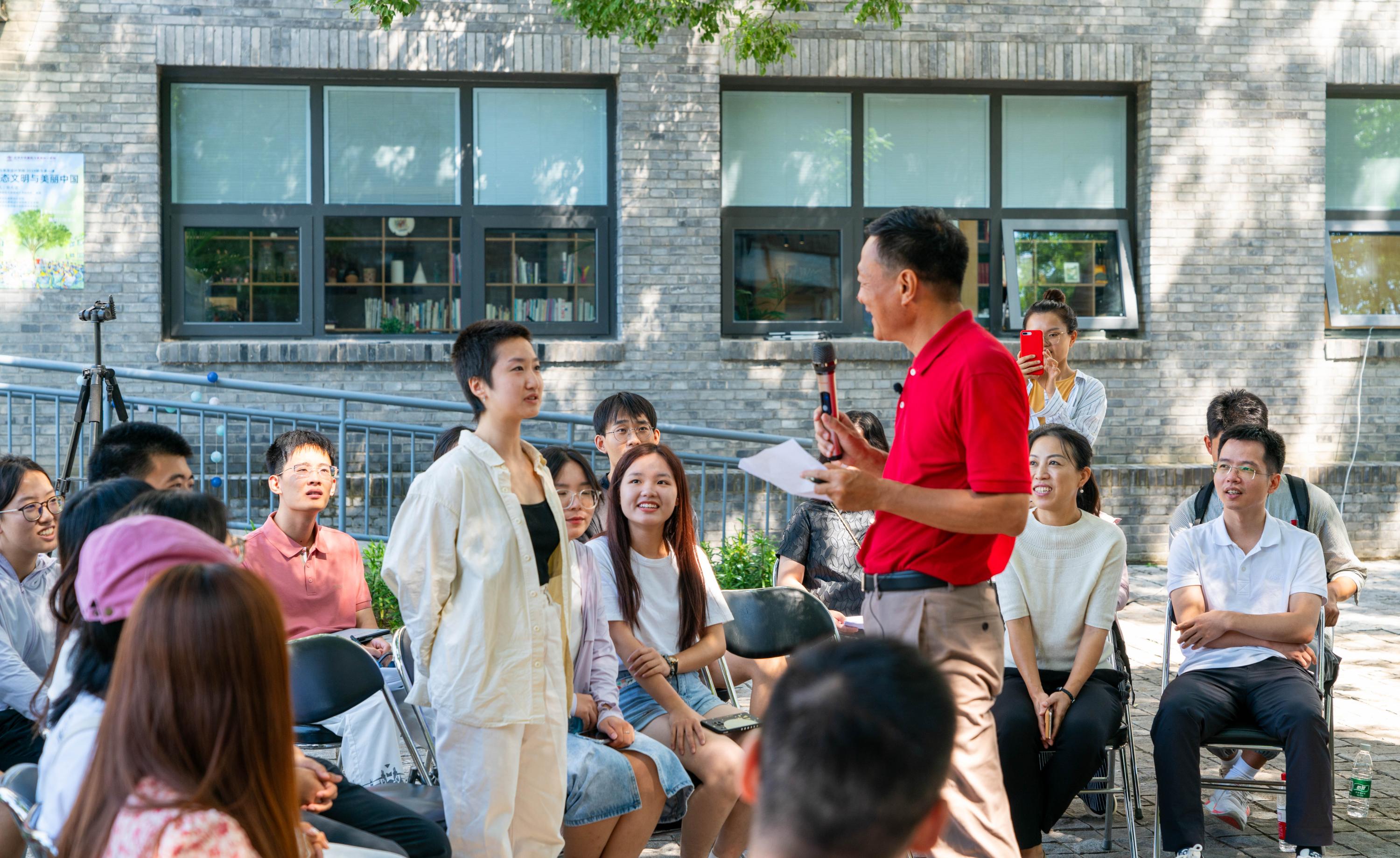
On 2 September 2024, Peking University's School of Architecture and Landscape Architecture welcomed its 2024 cohort of postgraduate students. The School organised a series of welcoming activities to help newcomers settle into campus life. Under the shade of locust trees, Dean Professor Yu Kongjian delivered the inaugural lecture titled ‘Ecological Civilisation and Beautiful China’, inviting students to embark on a journey to heal our planet.

Yu Kongjian led over thirty new students in gathering beneath an ancient locust tree, where each introduced themselves to deepen mutual understanding. Yu remarked, ‘The distinctive feature of our postgraduate cohort in Architecture and Landscape Design is this: some have two years' professional experience, others six, and some even ten. We come together to learn and exchange ideas.’ Why have we chosen to deliver this lecture beneath the locust shade today? Precisely to deepen our exchange. Learning should not rely solely on the classroom; what matters more is interaction. Our era has changed. Authority no longer resides with those who lecture or possess the most knowledge, but with those who demonstrate greater creativity. Those who stand apart will become the heroes of tomorrow. In the age of AI, conformity will swiftly lead to obsolescence."

Hao Ping, Secretary of the Party Committee of Peking University, accompanied by Deputy Secretary and Secretary of the Commission for Discipline Inspection Gu Tao, and Executive Vice Dean of the Graduate School Chen Peng, visited the School to extend greetings to the new students. Hao Ping remarked that it was a precious opportunity for students to listen to the inaugural lecture on ecological civilisation beneath the century-old trees, urging them to cherish this learning platform. He congratulated the new students on joining the School of Landscape Architecture and extended Teacher's Day greetings to the faculty and staff.

Peking University Party Secretary Hao Ping Visits School's New Students
During the inaugural lecture, Yu Kongjian elucidated the School of Landscape Architecture's intrinsic connection to the Party's programme objectives. He noted that the people's aspiration for a better life constitutes a shared goal pursued by both the Party and the populace, with the concrete vehicle for this objective being the ‘Beautiful China Initiative’ proposed at the 18th National Congress of the Communist Party of China. He emphasised that the societal form of a Beautiful China must align with core socialist values, embodying fairness, shared prosperity, and distinctive Chinese characteristics. The School's eight consecutive years of rural revitalisation initiatives exemplify this principle of shared prosperity. How can shared prosperity be achieved between urban and rural areas? How can shared campus resources be realised? These are precisely the challenges facing the design profession. Yu Kongjian further elaborated that the essence of landscape design lies in creating beauty, where beautiful landscapes and a beautiful society collectively shape a Beautiful China. The term ‘landscape’ derives from ‘land’ and “scape” (form), thus landscape design must possess a global perspective—encompassing geographical landscapes, ecological landscapes, and landscapes of profound form. The ‘Beautiful China’ envisioned by the 20th National Congress represents a Beautiful China under ecological civilisation, with ecological civilisation serving as a vital pathway to its realisation. Cultivating builders for this Beautiful China constitutes a core component of the School of Landscape Architecture's knowledge system and theoretical foundation. The essence of ecological civilisation lies in the harmonious coexistence of humanity and nature. Consequently, the core of landscape design is ecological design, whose heart lies in nature-based solutions. The NbS Asia Centre Innovation Base established within the School of Landscape Architecture embodies this very philosophy. Yu Kongjian urged students to uphold the Party's programme, engage in design that realises ecological civilisation and nature-based solutions, embark on a journey to heal the Earth within the School of Landscape Architecture, and collectively advance the construction of a Beautiful China.

Faculty and Students Group Photo
Freshers' Reflections on the “First Lecture of the Term”:
In September's Beijing, where gentle breezes prevail, amidst the warm courtyard shaded by locust trees, faculty and students radiated vigour and engaged in lively conversation, revealing the vibrant vitality of the School of Architecture and Landscape Architecture.
The opening lecture filled me with anticipation for my studies ahead. Professor Yu delivered an engaging presentation on ecological civilisation and Beautiful China, using accessible language. Achieving Beautiful China requires harmonious coexistence between humanity and nature, demanding that design approaches be grounded in nature's perspective rather than the designer's personal will. Nature-based solutions represent the optimal pathway to realising ecological civilisation and Beautiful China.
——Yan Jiaqi
Attending Professor Yu Kongjian's lecture was like partaking in a feast of ideas. It deepened my understanding of the relationship between the Party, national policies, and the discipline of landscape architecture, while offering fresh insights into the mission of landscape design within the framework of building a Beautiful China.
Professor Yu contextualised the Party's leadership and national policies within the broader landscape of design, making it clear that landscape architecture is not an isolated artistic pursuit but is intrinsically linked to the nation's developmental strategies. Under the Party's guidance, a series of policies chart the course for landscape design, compelling practitioners to integrate the principle of harmonious coexistence between humanity and nature into every project.
Beautiful China is no longer an abstract concept. Professor Yu's exposition vividly conveys that it embodies blue skies and white clouds beneath verdant mountains and clear waters; green spaces seamlessly integrated into urban landscapes; and idyllic rural vistas brimming with poetic charm. Landscape design plays a pivotal role in building Beautiful China. It must not only create aesthetically pleasing environments but also fulfil people's aspirations for a better life. Through meticulously designed public spaces such as parks, squares, and streets, individuals can find tranquil oases amidst their busy lives, savour nature's bounty, and appreciate life's beauty.
Landscape design enhances human wellbeing – a profound yet practical proposition. Well-executed design improves quality of life and mental health by providing recreational spaces that foster social interaction and strengthen community cohesion. Simultaneously, it safeguards the environment, mitigates natural disasters, and contributes to sustainable human development.
This lecture has profoundly illuminated that landscape architecture is a discipline imbued with responsibility and mission. As landscape designers, we must be guided by the Party's leadership and national policies, aiming to build a Beautiful China where humanity and nature coexist harmoniously. Our mission is to fulfil people's aspirations for a better life and advance human wellbeing. We must continually innovate design concepts and methodologies, striving to create a more splendid world.
——Li Peipei
Professor Yu's lecture beneath the tree canopy illuminated the essence and significance of ecological civilisation. It deepened my understanding of how our academy and discipline align with the Party and nation's endeavours, enhanced my professional awareness, rekindled my passion for the field, and clarified the sense of mission and responsibility we bear as landscape practitioners at Peking University. This experience proved immensely enriching and remains profoundly resonant.
——Li Shijie
Text by Wang Qing and Zhu Liangliang
Photographs by Ma Zhe
Edited by Zhu Liangliang
