[Class of 2025 Graduation] Graduate Representative Song Jia: Seeing Things as They Really Are
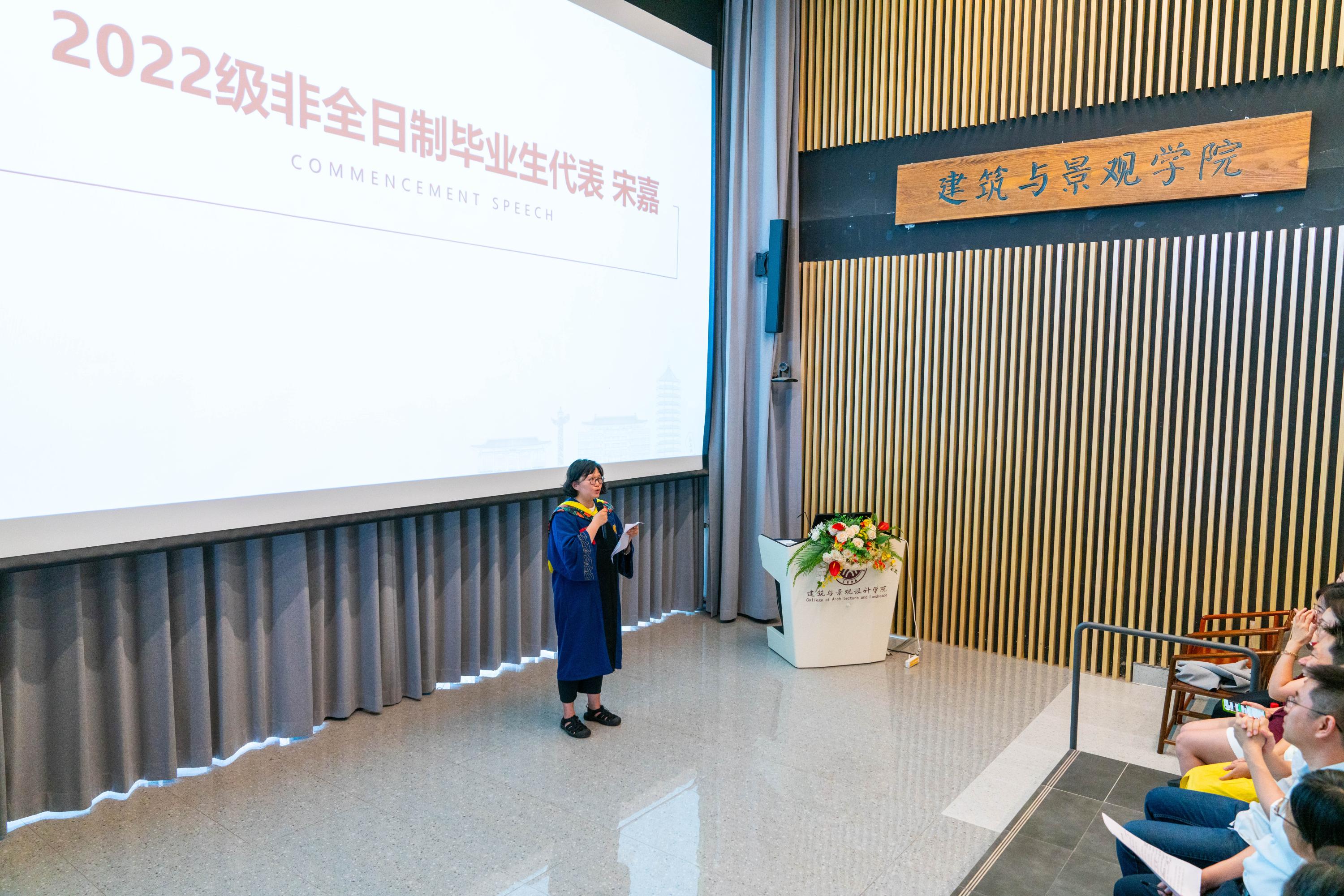
Hello everyone, I’m Song Jia.
In this sweltering June, as a working professional pursuing a graduate degree—and as someone working in the design field—I’ve come to feel the industry’s harsh reality even more keenly.
Although I’ve managed to graduate without a hitch, my colleagues and I face the risk of unemployment at any moment. I’ve also been wondering what the point of pursuing this graduate degree really is. I’ve been a designer for ten years, and I used to think I was quite good at it. I’m also about to enter middle age—burdened by a mortgage, gaining weight, and caring for both elderly parents and young children. Every day, I spend a lot of time with my children and my parents. Right now, I’m especially afraid of losing my job. I keep asking myself if I’m cut out for this industry. If I’m not, when should I switch careers? If I stay, I feel constantly on the brink, so I try to improve myself—which is why I even pursued a master’s degree. Now I have that research experience under my belt.
Throughout the process of writing my thesis, Professor Zhang repeatedly reminded me to return to the site, observe the real people living there, talk with them, constantly reflect on the causes behind appearances, see the connections underlying events, strip away the facades to reveal the truth—rather than rushing to solve problems. This seemingly simple task is actually the greatest challenge in research. To put it simply: seeing the reality.
Now, I’ve become a middle-aged designer with research experience who fears unemployment, and I’ve come to feel that I should be the standard-bearer for change in our industry.
I don’t care as much about appearances anymore; I care more about comfort. Just like the decorative, large plazas and artificial flower beds that Professor Yu has always rejected. I don’t think there’s anything wrong with being different from others. Just as none of us like standardized, uniform urban development. I care more about aesthetic depth—things that stand the test of time and are appropriately scaled. Just as Professor Pang Wei has urged that, during periods when landscape design is not busy or thriving, we should focus on developing an understanding of landscape concepts and cultivating landscape aesthetics—tasks that are more important and urgent than landscape design itself.
Because I have elderly parents and young children, I’m better able to understand their genuine needs—just as Professor Li has consistently exposed the “hidden violence” cities inflict on marginalized groups and offered a path of nonviolent non-cooperation. Out of fear of unemployment, I take even the most inconspicuous spaces in a project seriously and execute them well. Moreover, as I’ve grown older, I no longer automatically say, “Costs aren’t my responsibility”; I’ve become a middle-aged person who manages finances carefully.
Now I’ve spread my wings in research, which has carried me into the midst of real people and the land—to discover, to see, and to give voice to their stories.
So I want to thank every teacher and classmate who has helped shape me into who I am today:
Thank you to my advisor, Zhang Tianxin, for helping me see myself.
Thank you to Professor Yu for encouraging us to “remain true to our uniqueness.”
Thank you, Professor Li, for teaching us to return to common sense, to our senses, and to the simplest form of human compassion.
I’d also like to extend special thanks to Professor Ma Yue, who didn’t mind my offensive remarks or erratic behavior, but instead accepted and protected my true self—a middle-aged designer afraid of unemployment who has some research experience.
Wishing everyone a joyful graduation and a bright future!
Photography by Ma Zhe
Edited by Zhu Liangliang
