Returning to the World of Mortals—2025 Commencement Address
Dean Yu Kongjian
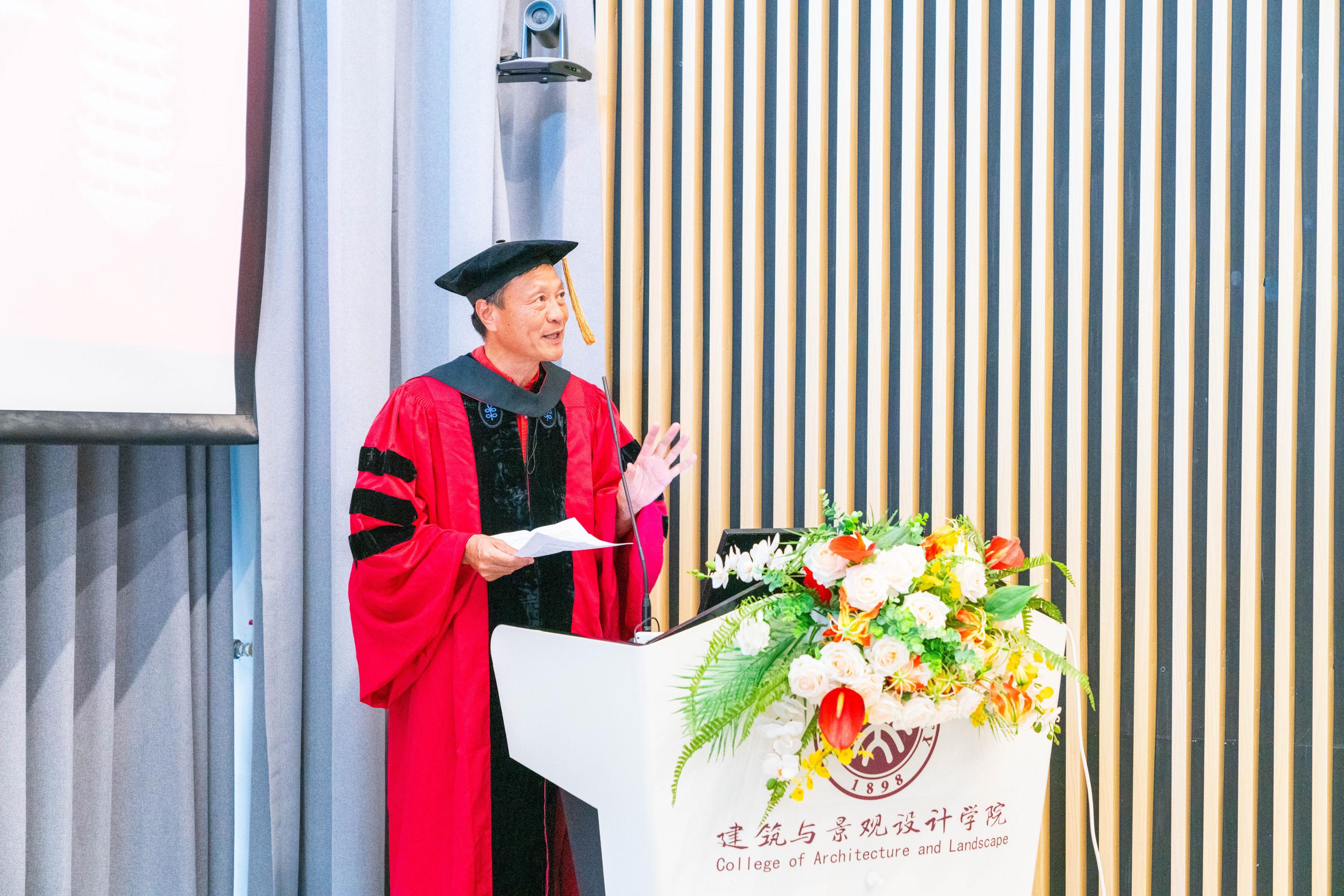
Dear Class of 2025:
Today marks an important milestone in your lives. On this campus, steeped in dreams and hard work, we gather for a solemn farewell ceremony. As your teacher—and as a designer and dreamer who has always straddled the line between the field and the classroom—I stand here not to deliver flowery platitudes, but to offer you a piece of advice that may not be trendy, yet is of the utmost importance: “Return to being mere mortals.”
The phrase “ordinary mortal” may sound mundane, even slightly derogatory, as if it were a compromise with the mundane and the mediocre. But let me tell you this: in this era full of challenges—global climate change, urban-rural social transformation, the shift between civilizations, and especially the rapid development of AI—for you, who are about to step out of these gates, enter society, and face the real world, these four words represent precisely your rarest and most valuable ability.
What does “ordinary mortals” mean? It means truly seeing the land as it is, sensing the scent of water, hearing the sighs of ordinary farmers, and feeling the warmth of the common people. It means using your unfiltered intuition, experience, and physical presence to gauge the reality of a place, rather than relying solely on models, parameters, satellite images, and AI to make judgments.
Just a few days ago, I returned to campus from the most remote villages in our country. Before I even had a chance to catch my breath, a student enthusiastically approached me: “Professor, you’ve gotten even more tanned!” I replied with a smile: “That’s right. Two consecutive weeks of fieldwork have once again pulled me away from screens and meetings and back into the real world—and helped me rediscover my ‘ordinary eyes.’”
Do you know what I saw?
The air-conditioned bus I was riding in sped along the highway, with eye-catching slogans and high-end renderings visible through the window—a water diversion project costing tens of billions was about to begin, aiming to channel clear water from beyond the mountains to dilute the polluted river right before our eyes. Beside it, fleet after fleet of pollution-removal boats were working tirelessly to scoop up blue-green algae and water hyacinths, with tens of millions spent here every year; while pig farms in villages within a few hundred meters of both banks have all been demolished and relocated, at a cost of billions. All of this paints a magnificent panorama of modern ecological governance across the nation.
I began to have my doubts!
So I got out of the car and walked upstream along a stream valley. A pungent odor filled the air, and dead fish and dying frogs floated on the water’s surface. I slipped into a farmer’s pigsty and saw wastewater flowing out in a steady stream. What should have been a treasure for the fields has now become a “source of pollution.” And right next to it, in the rice paddies, villagers were generously spreading bright white chemical fertilizers—which are both convenient and cheap to use.
Further ahead lay a patch of abandoned farmland. A villager said helplessly, “ ‘We can’t grow cash crops here, nor can we plant trees. They say this land has been designated as “basic farmland,” so we can only grow grain—but even that makes us lose money.’” I asked him, “Well, could you renovate it and restore it as a wetland?” He shook his head: “The red line has already been drawn; we can’t touch it.” It turned out this was a farmland boundary line demarcated by an expert using GIS technology—the arable land red line had actually been drawn all the way from a steep slope to the very center of the river…
I continued walking up the mountain along a newly built dirt road that wound its way upward, ending at a newly constructed pig farm. It turned out that, in the name of “ecological relocation,” the pigsties that had originally been by the riverbank had been moved to the mountaintop. What does this mean? It means blasting through the mountain to clear a path, building roads, and installing water supply systems—all while completely destroying the original natural vegetation and streams.
Questions echoed through my mind:
Why couldn’t the money spent on removing blue-green algae be used to help villagers build a manure collection system?
Why not use just a fraction of the funds allocated for the water diversion project to return the nutrient-rich water to the fields and turn waste into a resource?
Why can’t we restore that “basic farmland” along the riverbank and on the hillsides into ponds that are richer and serve multiple ecological functions—allowing nature to cycle nutrients and purify the water on its own, and providing habitats for fish and frogs? And breeding grounds for birds?
Have we been blinded by utopian visions of idyllic countryside and sophisticated technology? Have we forgotten that many problems can actually be solved through the simple realities of daily life and common sense?
We pursue “smart technology,” “standardization,” and “big data governance,” but those algorithms cannot see dead fish or the hardships of farmers. We develop cutting-edge technologies, yet we overlook the simplest truths of the land—that those who cultivate the land understand it, and those who use water cherish it. While we sketch out blueprints worth hundreds of billions on paper, in reality we silence the land and leave farmers voiceless.
Dear students, today you are about to leave campus and enter society. You will join the ranks of those advancing scientific and technological development, including the more than 2,000 master’s and doctoral graduates from our college. Among you, some may become decision-makers for projects worth tens of billions, lead designers of GIS systems, chief commanders of “Smart Land Management,” or promoters of smart agriculture. You will possess knowledge, power, and grand visions—the capital and potential to rise above the limitations of mere mortals.
But please remember this: a truly grand vision is not measured by the size of the investment or the grandeur of the construction, but by how many lives it truly benefits.
Do not confine yourselves to offices, air-conditioned cars, and reports; please go out into the world—ask villagers about their aspirations, breathe in the scent of the earth, see if there are lively fish and shrimp in the streams, and observe whether children can play safely and happily. Only by using your seemingly “ordinary” eyes can you truly connect with heaven, earth, and humanity, and make judgments guided by your conscience.
May you, on your journey ahead, continue to retain this pair of “ordinary, mortal eyes,” a body willing to bend down and stoop, and an ordinary heart willing to listen to the voices of the land and the people.
May you not only sketch out a blueprint for our magnificent and beautiful homeland but also preserve the genuine warmth and unassuming lives found in the fields and farmlands. May you carry this “ordinary, mortal” insight and understanding as you survey the mountains and rivers and realize your ideals, truly allowing knowledge, technology, and power to take root and benefit all living beings.
With this, I offer words of encouragement to you all. May your future be bright and promising!
Photography by Ma Zhe
Edited by Zhu Liangliang
