Chen Liang, Director of the Department of Ecology and Environment of the Guangxi Zhuang Autonomous Region, Meets with President Yu Kongjian
On June 7, Chen Liang, Secretary of the Party Leadership Group and Director of the Department of Ecology and Environment of the Guangxi Zhuang Autonomous Region, met with a delegation led by Yu Kongjian, President of our College, in Nanning. The two sides engaged in in-depth discussions on the management and ecological restoration of the Jiuzhou River Basin. Huang Ying, Member of the Party Leadership Group and Deputy Director of the Guangxi Department of Ecology and Environment, along with relevant officials from the department’s divisions and affiliated units, as well as responsible officials from the Yulin Municipal Bureau of Ecology and Environment, Bobai County, and Luchuan County, attended the meeting.
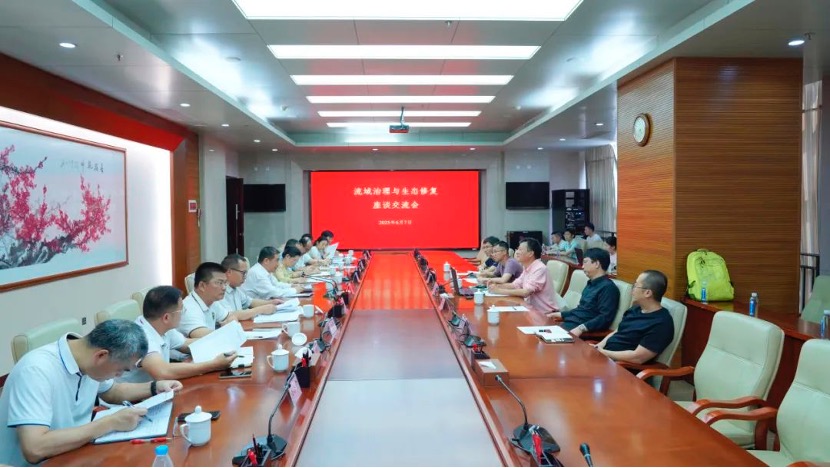
Chen Liang extended a warm welcome to President Yu Kongjian and his delegation. Chen Liang noted that the ecological infrastructure governance model advocated by President Yu Kongjian is a vivid reflection and concrete implementation of Xi Jinping’s Thought on Ecological Civilization. It provides highly valuable concepts and methods for watershed management and ecological restoration, and holds significant guiding importance for promoting improvements in the ecological environment of the watershed and achieving sustainable development.
Chen Liang emphasized that the Jiuzhou River is a major interprovincial waterway connecting Guangxi and Guangdong, serving as the primary source of drinking water for Zhanjiang City in Guangdong Province. The ecological and environmental security of the river basin is of great significance to the overall cooperation between Guangdong and Guangxi. Therefore, high priority must be given to the ecological protection and restoration of the basin; we must adhere to a practical approach as the priority and innovation as the driving force, let our achievements speak for themselves, and seek evaluation from the people. We must implement precise measures and carry out genuine, substantive reforms to address environmental issues in the Jiuzhou River basin, and under no circumstances should we engage in superficial measures or adopt a complacent, passive attitude. We must earnestly implement the relevant instructions and requirements from the autonomous region’s leadership, resolutely shoulder our political responsibilities, foster a situation where all levels work together to protect the ecosystem, and expedite the development of a scientific management plan tailored to the Jiuzhou River basin, thereby revitalizing the basin’s ecological vitality.
Yu Kongjian pointed out that the Jiuzhou River basin experiences alternating droughts and floods, has a fragmented water system, and suffers from prominent non-point source pollution from aquaculture. The basin’s safety capacity, environmental capacity, ecological capacity, and social capacity are insufficient, making it difficult to fundamentally resolve its environmental issues using industrial governance models. He suggested drawing on the wisdom of traditional Chinese culture regarding the harmonious coexistence of humans and nature, adopting planning approaches to build ecological infrastructure and ecological engineering design methods that follow the ways of nature. With water as the core, we must thoroughly grasp the four key principles: transforming pollution into fertilizer, decentralized absorption, removing hard surfaces to restore vitality, and living in harmony with water—using the model of ecological civilization to address the pollution caused by industrial civilization.
Source: Department of Ecology and Environment of Guangxi Zhuang Autonomous Region
Edited by Zhu Liangliang
