Professor Yu Kongjian Wins the 2020 Sir Geoffrey Jellicoe Award
At 8:00 p.m. Beijing time on October 8, the award ceremony for the Sir Geoffrey Jellicoe Award, presented by the International Federation of Landscape Architects (IFLA), was held in a hybrid online and in-person format. Professor Yu Kongjian of Peking University was awarded the 2020 Sir Geoffrey Jellicoe Award. Peking University set up a satellite venue in the Moonlight Hall of the Yingjie Exchange Center. Entrusted by the International Federation of Landscape Architects (IFLA), President Hao Ping attended the awards ceremony and presented the award to Yu Kongjian. Vice President Huang Ru, He Canfei, Dean of the School of Urban and Environmental Sciences, Peng Feng, Dean of the School of Art, and heads of relevant administrative departments also attended the ceremony.
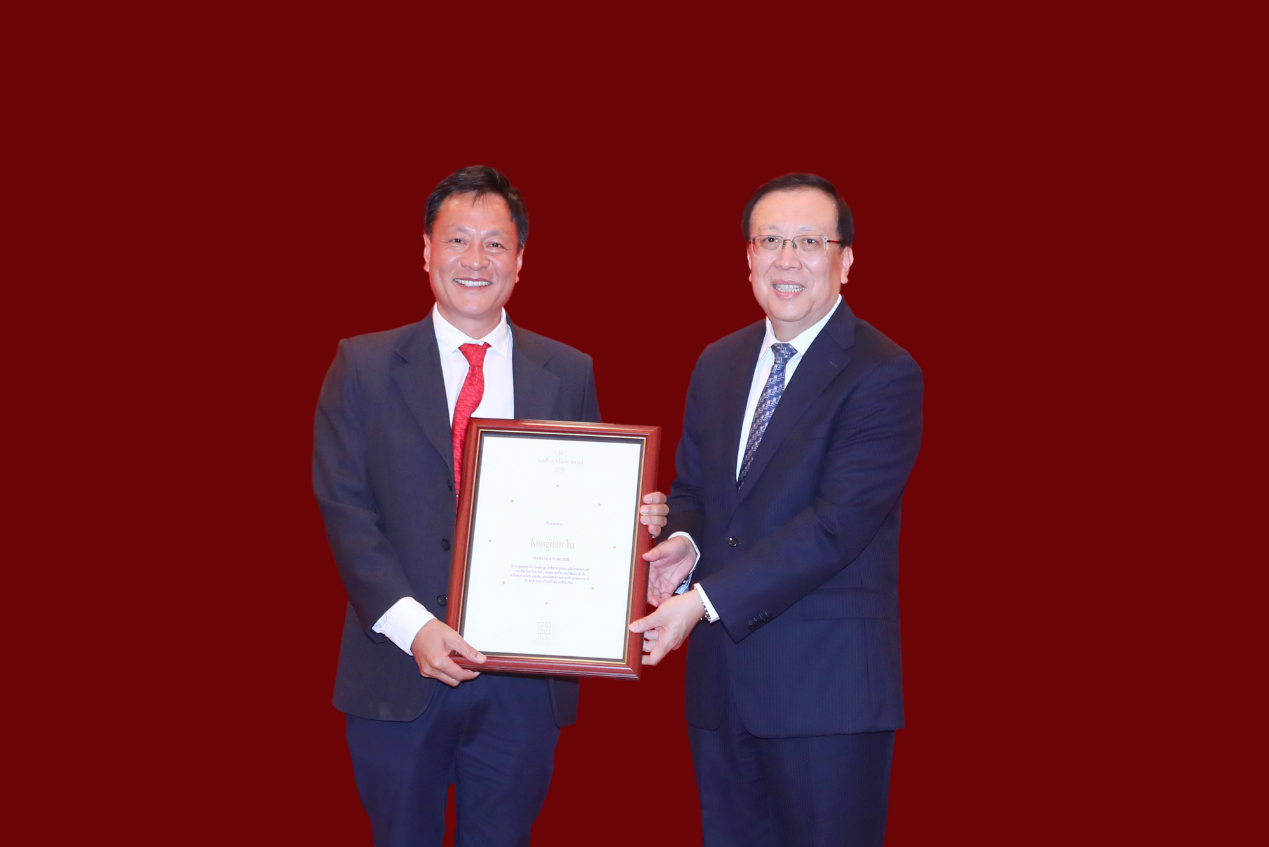
Hao Ping Presents the Award to Yu Kongjian
Gareth Doherty, Chair of the Sir Jericho Award Nomination Committee of the World Federation of Landscape Architects and a professor at Harvard University, outlined the judging process for the 2020 Sir Jericho Award: Following a rigorous selection process involving multiple rounds of evaluation, the committee ultimately decided to award the 2020 Sir Jericho Award to Yu Kongjian, a professor at Peking University. A video was shown at the conference in which scholars from the landscape architecture community around the world extended their congratulations to Professor Yu Kongjian.
James Hayter, President of the World Federation of Landscape Architects and Professor at the University of Adelaide in Australia, announced the award. James Hayter congratulated Professor Yu Kongjian on receiving the Sir Jericho Award and outlined the history and major achievements of the World Federation of Landscape Architects and Landscape Architecture. James Hayter noted that Professor Yu Kongjian is one of the most influential landscape architects in the world today; his design work, lectures, and educational activities have had a profound impact on professionals, students, and the general public, actively transforming people’s perceptions of the landscape architecture profession.

Remarks by James Hayter
In his remarks, Hao Ping first congratulated Professor Yu Kongjian on receiving this honor and spoke highly of the positive contributions Professor Yu Kongjian and his team have made to China’s ecological civilization efforts. He emphasized that the outbreak of the COVID-19 pandemic has further prompted us to reflect on the relationship between humans and nature and to consider ways to achieve comprehensive harmony between the two, noting that landscape architecture will play a vital role in this process. Hao Ping stated that Peking University will leverage the strengths of its comprehensive disciplinary system to advance the continuous improvement of landscape architecture, thereby making new contributions to improving the human living environment and ecological conditions and building a more harmonious and beautiful world.
Yu Kongjian delivered a speech titled “My Journey to Heal the Earth.” He began by expressing his gratitude to the International Federation of Landscape Architects and the selection committee. He remarked that, as a faculty member at Peking University, receiving the Sir Jericho Award is not only a personal honor but also a recognition by international peers of Peking University and China’s achievements in the field of landscape design research. In his speech, he detailed his key academic perspectives—drawing on his upbringing, educational background, and design projects—and shared his unique understanding of the discipline of landscape design.
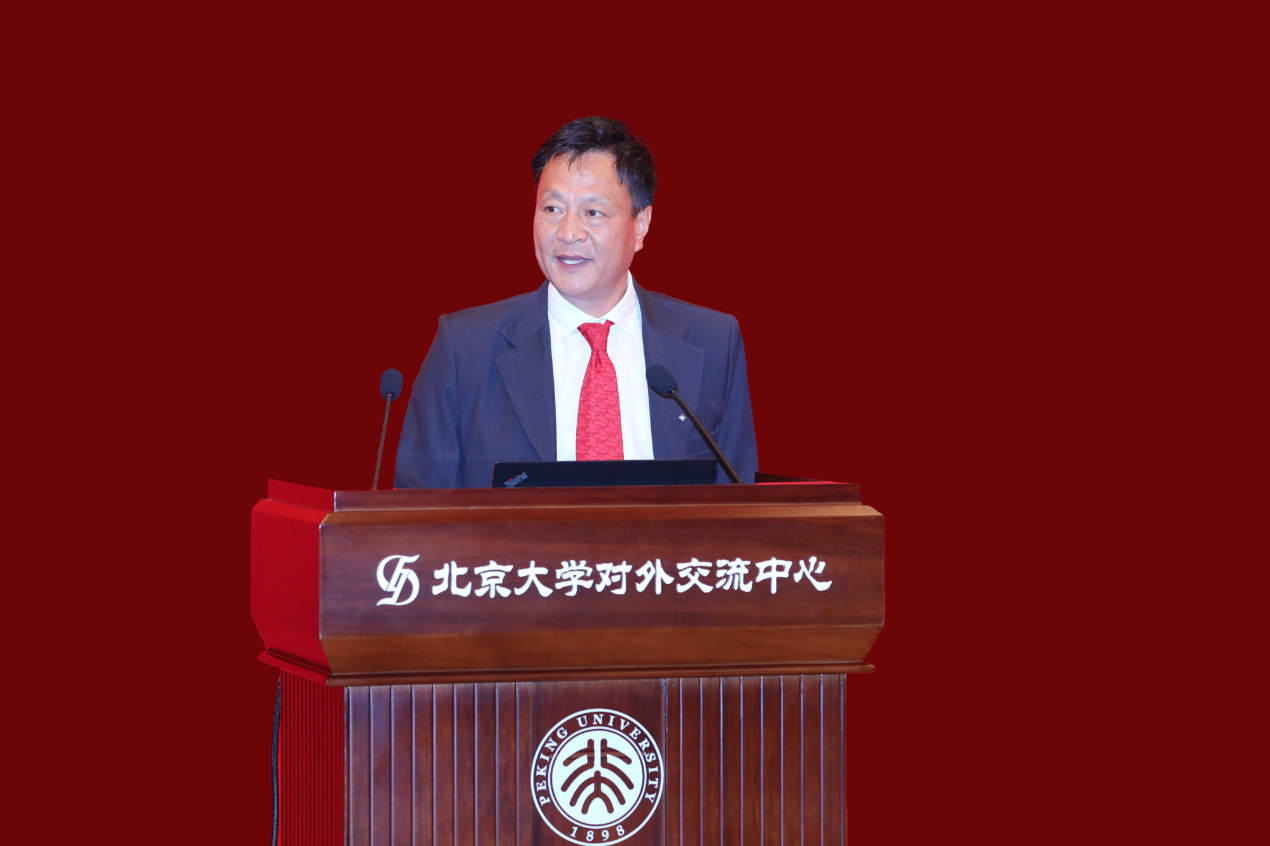
Yu Kongjian Delivers a Speech
Since the 18th National Congress of the Communist Party of China, the Party Central Committee, with Comrade Xi Jinping at its core, has incorporated the advancement of ecological civilization into the overall strategic layout of socialism with Chinese characteristics. Drawing on traditional Chinese ecological wisdom and implementing nature-based solutions, Yu Kongjian and his team have designed and completed more than 500 high-quality projects in over 250 cities across China and more than 10 other countries over the past 20 years. They have made unique contributions to ecological conservation, ecological restoration, and sponge city construction. As steadfast practitioners of China’s ecological civilization, they have put Chinese wisdom to work in global sustainable initiatives, earning full recognition from the international academic community and their peers.
The Sir Jericho Award is the highest lifetime achievement award in the fields of global human settlements and landscape architecture. It carries significant international influence and is often referred to as the “Nobel Prize of human settlements and landscape architecture.”
Appendix: Yu Kongjian’s Biography
Yu Kongjian is a professor at Peking University and a member of the American Academy of Arts and Sciences. He holds honorary doctorates from the University of Rome and the Norwegian University of Life Sciences. He received his Ph.D. from Harvard University in 1995 and returned to China in 1997 to establish the School of Architecture and Landscape Architecture at Peking University, serving as its first dean. He also founded the journal *Landscape Architecture* and serves as its editor-in-chief. He serves as Vice Chairman of the China Urban Science and Technology Association; Chair of the Professional Committee on Landscape Architecture and Beautiful China; Vice Chair of the National Sponge City Expert Committee; and Vice Chair of the Professional Committee on Human Settlements under the Ministry of Housing and Urban-Rural Development.
Yu Kongjian regards urban and landscape design as “the art of survival.” He advocates for an eco-priority approach to national land-use planning, as well as the concepts of “sponge cities” and “sponge landscapes,” and proposes comprehensively addressing urban and rural ecological and environmental issues through the construction of ecological infrastructure. He has received 31 prestigious international awards in his field, including 13 American Landscape Architecture Awards, 5 World Architecture Festival Global Best Landscape Awards, 3 International Architecture Awards, and 2 American Architecture Awards. He has also been honored with the ULI (Urban Land Institute) Global Excellence Award and the Gold Medal at the 10th China National Art Exhibition, among other major domestic and international accolades. More than 20 of his projects have been featured in professional textbooks at universities in Europe and the United States.
Source: Converged Media Center, Office of the College of Architecture and Landscape
Editor: Zhu Liangliang
